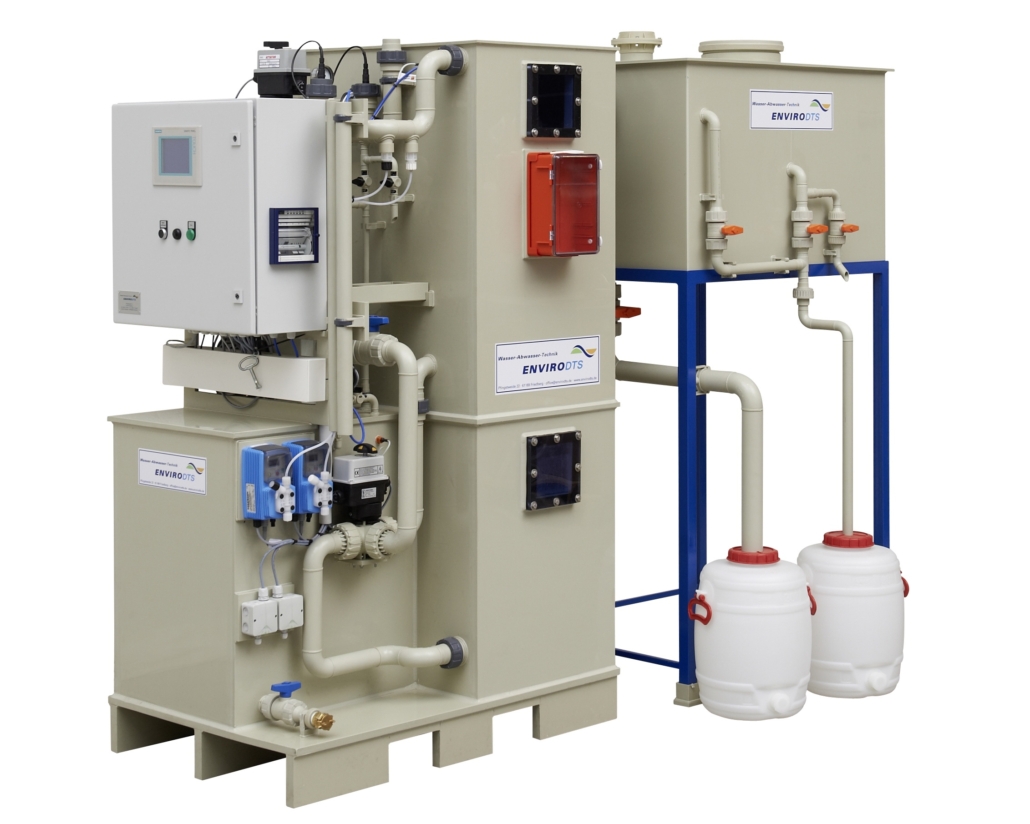
Laboratory Wastewater Neutralization: A Key to Environmentally Friendly Research

Effective strategies and technologies for treating laboratory wastewater

Procedure Description

An increasing amount of laboratory wastewater from laboratory and industrial settings must be neutralized. The reason: an increasing amount of fully desalinated—and therefore unbuffered—water is being used for increasingly sophisticated experiments. In these cases, even small concentrations of acids or bases can cause a significant shift in the pH value.

Neutralization systems adjust the pH level of wastewater by treating it with acids or bases. The goal is to achieve a neutral pH level to enable discharge into the environment or further treatment processes. Such systems are essential for preventing corrosion in wastewater systems and minimizing environmental impact from acidic or alkaline wastewater. They are used in industries that handle pH-sensitive waste, including laboratories and manufacturing facilities.

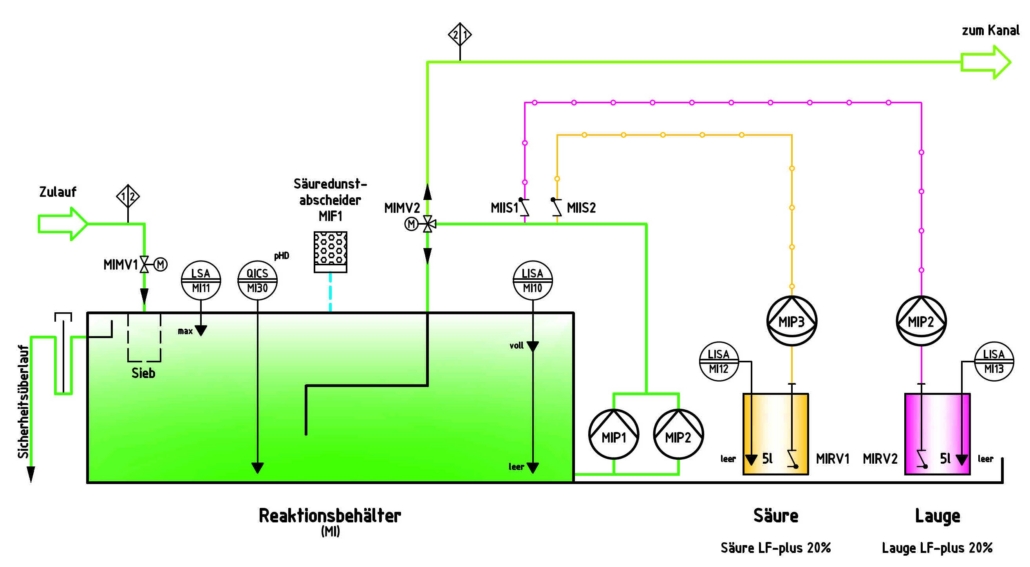
Flowchart of the neutralization process

Batch and continuous processing systems MiniFix and NeutroFix

In a MiniFix or NeutroFix neutralization system, laboratory wastewater is collected in the reaction tank. When the liquid level reaches capacity, the laboratory wastewater is pumped out or thoroughly mixed. At the same time, the pH value of the wastewater is measured.

Depending on how much the pH value deviates from the setpoint, the acid or alkali valve is activated. The chemicals are metered from the storage tank. If the pH value deviates more significantly from the setpoint, more chemicals are added. If the deviation is smaller, fewer chemicals are metered into the reaction tank.
This adjusts the pH value of the laboratory wastewater. As soon as the pH value is within the permissible limits, the contents of the reaction tank are completely pumped out of the neutralization system and the wastewater is discharged into the sewer.
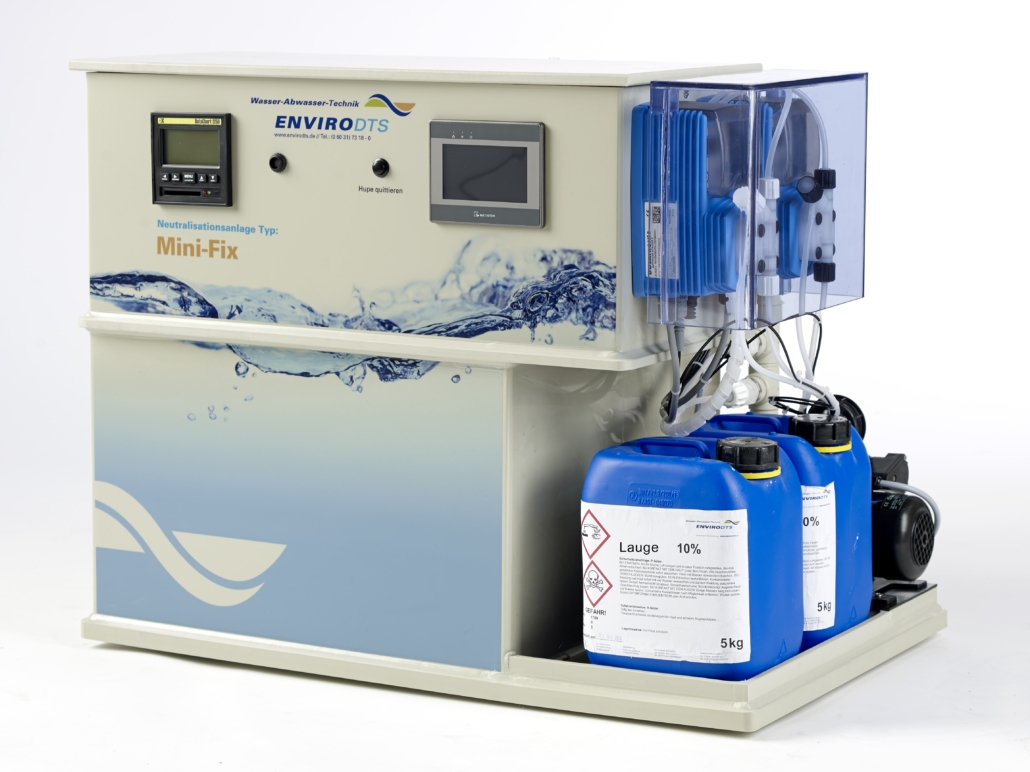
MiniFix

The MiniFixcompact systemis designed to fit even in laboratory fume hoods. Despite its compact dimensions, it features fully automatic controls, a sealed design, and high-quality dosing and measurement technology. As a result, the system achieves a neutralization capacity of up to 300liters per hour.

  • Neutralization capacity up to 300 l/h
  • Compact design
  • Fully automatic pH control
  • Easily accessible components, simple maintenance
  • closed and odor-tight system
MiniFiX

NeutroFix 1K

The NeutroFix series of neutralization systems has proven itself over many years. The purpose of these neutralization systems is to safely neutralize laboratory wastewater or perform further detoxification. The NeutroFix 1K system (the “K” stands for “Compact”) is a further development of the NeutroFix 1 model. This system is characterized by a significantly smaller design while maintaining the same performance. A 500-liter buffer tank is additionally integrated into the system. Wastewater neutralization is performed at a rate of approximately 1 m³/h.

  • Flow rate: 0.3 to 1 m³/h
  • Compact design
  • Low inlet height possible (max. 675 mm above the floor)
  • Custom programming available
  • closed and odor-tight system
NeutroFix 1K

NeutroFix 3K

With a system capacityof approximately 3 m³/h, the NeutroFix 3K is suitable for the cost-effective neutralization of larger wastewater streams. At its core is a 700-liter reactor tank, in which the wastewater is thoroughly mixed by chemical-resistant centrifugal pumps and automatically adjusted to a neutral pH range. Control is handled by a Siemens PLC (S7-300) with a touch panel, which enables convenient operation, high process reliability, and integration with the building management system.

  • Capacity of approximately 3 m³/h
  • High process reliability thanks to an additional final inspection
  • custom programming
  • Proven reliability thanks to robust construction
blank

NeutroFix R

The design is extremely compact, yet this wastewater neutralization plant is also capable of treating large volumes of wastewater. A pressure reactor developed specifically for the plant forms the core of the system, which also includes a Venturi system used to meter and feed the chemicals. One such plant can be viewed at the Max Planck Institute in Heidelberg, where it has been in operation for years. There, it is combined with a sediment trap, a large buffer tank measuring ten cubic meters, and a pressure reactor tank. This configuration enables a throughput of up to 20 cubic meters per hour.

  • Capacity of approximately 20 m³/h
  • Proven reliability thanks to robust construction
  • The flow-through tube principle results in more accurate pH measurements and shorter response times, leading to more precise chemical dosing
  • lower chemical consumption and, therefore, lower operating costs
NeutroFix R Customer System

Successfully implemented – our reference projects

New DECHEMA Research Building in Bad Homburg

  • Neutralization MiniFix
  • 3 MiniFix 2025

Curecav Tübingen

  • NeutroFix 1K

Ferdinand Braun Institute of the Leibniz Institute, Berlin

  • NeutroFix 3K
  • NeutroFix 3K with additional arsenic filters / selective ion exchangers

Wolfra Winery, Erding

  • NeutroFix Reactor
  • 60 m³/h

Your contacts

Volker Luh

Volker Luh

B.S. in Engineering

Phone: +49 6031 7318 24
Email: volker.luh@envirodts.de

Andreas Koch

Andreas Koch

B.S. in Engineering

Phone: +49 6031 7318 23
Email: andreas.koch@envirodts.de