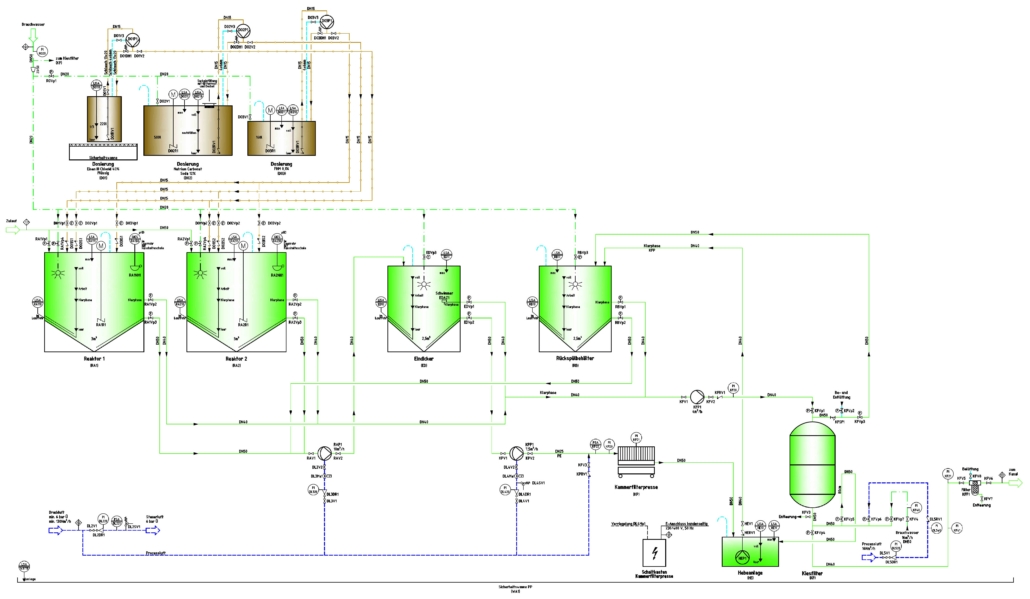
Precipitation and flocculation are key processes in wastewater treatment designed to effectively remove dissolved and colloidal contaminants. In precipitation, chemical coagulants, such as aluminum sulfate or ferric chloride, are added to the wastewater. These coagulants react with the pollutants dissolved in the water to form poorly soluble compounds that precipitate as flocs. This process makes it possible to remove a wide range of contaminants, including heavy metals and phosphates, from the water and significantly reduce the pollutant load.
This is followed by flocculation, in which flocculants (polymers) are added to the wastewater to aggregate and enlarge the formed flocs. These larger flocs settle more quickly and can be removed more easily through sedimentation or flotation. The combination of these two processes ensures high efficiency in wastewater treatment and enables compliance with strict environmental regulations. Our precipitation and flocculation systems are designed to optimally control this process and to be individually tailored to the specific requirements of your wastewater streams.
 MADE IN GERMANY